ctrl+v
Showing posts with label stars. Show all posts

Monday, 17 November 2014

Practising mindfulness during the Leonids meteor shower

Tonight I will be practising mindfulness watching the Leonids meteor shower in my back garden under a warm blanket!

The Leonids meteors can be seen at their peak around the 16th to the 18th November. They are one of the most impressive showers to observe, with around 40 meteors per hour at their peak.  This year only a modest 10-15 have been predicted however. The shower itself has a cyclical peak year every 33 years where hundreds of meteors can be seen each year, the last of these was in 2001, lets look forward to 2034 then! Our crescent waning moon is at 25% of her brightness at the moment so that should make for fairly good viewing of this impressive meteor shower.

In order to locate the Leonids, look in the direction of the constellation Leo, the best time is just after midnight. The brightest object in the sky right now, the planet Jupiter is also near the radiant point which should make it easier to locate where the meteors will be originating.
 
earthsky.org
Here are some viewing tips from earthsky.org

“Here’s another tip regarding the radiant point. As darkness falls in mid-November, the radiant point of the shower is below your horizon, as seen from all parts of Earth. As the Earth turns, the constellation Leo the Lion – carrying the meteor shower radiant point – will rise over your eastern horizon. Expect to see the constellation Leo in the east around midnight. That’s why the Leonids begin to pick up steam after the midnight hour!
Just remember, you don’t have to locate a meteor shower radiant to watch the meteor shower.
But if the radiant isn’t in the sky, you won’t see as many meteors. That means you should watch the Leonid shower tonight, from late evening (November 17) until dawn (November 18).
As a general rule, the higher the meteor shower radiant climbs in your sky, the more meteors that you’re likely to see. The radiant for the Leonids is highest up during the dark hour before dawn, offering, perhaps, 10-15 meteors per hour. The moon may marginally interfere with the show, but not enough to worry about. You should see at least a sprinkling meteors, if you watch for an hour or so.

What else can you see on the night of the 2014 Leonids peak? The radiant for the Leonids is near the star Algieba in Leo. This is not Leo the Lion’s brightest star. That distinction goes to Leo’s star Regulus. Watch for both of these stars.
accuweather.com
Both Algieba and Regulus belong to a noticeable pattern on the sky’s dome, in the shape of a backwards question mark. This pattern is called “the Sickle.” The paths of Leonid meteors can be traced backwards to the Sickle pattern, which is a famous asterism – or noticeable star pattern – within the constellation Leo.”
Watching meteors fly through our night sky can be an intensely spiritual experience. The wonder of a shooting star is something that stirs a deep emotion within us. Spending an hour or two watching a shower is a wonderful way of really practicing a meditative mindfulness, try to really concentrate on the night sky and empty your mind of all other thoughts. Become completely absorbed in what is happening in the heavens above you and allow yourself to be almost transported to that other plane as if you yourself were in amongst the shooting stars. As you still your mind you will feel it is just you and the night sky and it is a wonderful feeling. Make sure you wrap up warm though and enjoy your wonderful mindful meteors!
Wishing on a shooting star! Blessings, Alison xxx

Friday, 8 August 2014

Supermoon in Aquarius August 10th 2014 and Perseid Meteor Shower. Feel the amazing energy.

This August we are blessed with the brightest Supermoon of 2014.  August’s supermoon will reach her fullness at 1.10pm CDT 18 10 UT on August 10th 2014.  She will have reached her closest point to earth just a few minutes earlier at 12.44 CDT. The fact that these two phenomena co-incide means that this supermoon will be a particularly spectacuar event this August. At this point of perigree she will be just 221,765 miles away from earth, our supermoon won’t be as close as this again until September 2015.


We have three supermoons this year, the first was in July, did any of you see it? I didn’t manage it as it was cloudy here! The third supermoon will be in September. August’s supermoon will be the most spectacular though, being closest to our earth of the three so will surely prove to be an event not to be missed. Supermoon’s are on average 14% larger and 30% brighter but I can’t find a statistic of how much brighter this August moon will be, she sure will however be a sight not to be missed!
 
Super mini moons astroblogger.com


The best time to view our wonderful moon will be just as she rises which will be just after sunset on Sunday.  The moon on the horizon always seems to look larger than when she is is high in the sky, this is because of what is known as the ‘Ponzo Illusion’

“Most supermoons appear larger than they really are because of what's called the "Ponzo Illusion." First put forth in 1913 by Italian psychologist Mario Ponzo, it holds that the human mind judges the size of an object based on its background.
Most people perceive the horizon as being farther away than the point straight above their heads. "When the moon is on the horizon, your brain thinks it’s far away, much farther than when it’s overhead," writes Phil Plait in his Bad Astronomy blog. "So the Ponzo Illusion kicks in: Your brain sees the moon as being huge, and it looks like you could fall into it." http://www.al.com


August’s Supermoon also coincides with the Perseids meteor shower, her super brightness will mean that the Perseids may be a little harder to view this year. There will be a lot of energy however happening in the skies above us. This will be quite a turbulent and power fuelled time for all of us!
 
Perseids from VEoz.com
This Supermoon will be in Aquarius. Although the time of the full moon will be a turbulent one it will bring about a breaking down of barriers and a releasing of any pent up emotion that needs to be let go of. Aquarius is an air sign known for shattering perceptions and breaking rules. You will emerge feeling cleansed and refreshed. Let go of all that you do not need, break down those walls, you will feel so much better for it.

The August Supermoon is also the Lunar Lammas falling midway between the summer and Autumn Equinoxes. Lammas or Lughnasadh is a celebration of the first harvest, of giving thanks for the fruits of our labour and looking forward to the months ahead.

Our supermoon this August has many names given to it, it has been called the Grain Moon, Mating Moon, Chokeberry Moon, Summertime Moon, Corn Moon , Moon when Cherries Turn Black and the Barley Moon.


One interesting name is the Dog Day’s moon which refers to the hot days of the late summer in the northern hemisphere that occur in late July and August. The Old Farmer’s Almanac lists the traditional period of the Dog days as the 40 days beginning July 3rd and ending august 11th.  The name Dog Days was believed to originate from the ancient Romans and Greeks who named these days after the star Sirius, the Dog Star, brightest star in the sky. The Dog Days originally were the days when Sirius rose just before or at the same time as sunrise, this was known as a heliacal rising.

Enjoy this Aquarius Supermoon. Pass through this time of turbulence and emerge refreshed at the other end. Hopefully you will have caught a glimpse of some of the wonderful Perseid meteors to light your path along the way!

Supermoon blessings to you, AstarteAlison xxx

Thursday, 7 August 2014

Perseid Meteor Shower Supermoon August 2014

The Perseid meteor shower is happening now with the peak viewing night on the 12 th August 2014. Meteors from the Perseid shower may be visible right until 22nd August so you will have plenty of time to try and spot a meteor or two. The nearly full moon will present a bit of a problem this year throwing out a lot of light thus hiding a lot of the meteors in her glare but you should still be able to spot some fabulous meteors. In addition this full moon is a supermoon thus her light will shine even more brightly to obscure some of those meteors. The best thing that you can do is get as far away as you can from urban light, lie down on a blanket and enjoy the show, even if you don't see many meteors you can still enjoy being out in the darkness and enjoy the strength and energy emanating from our August supermoon

The perseids are named because they radiate from the Perseus constellation. The best time to observe them is after midnight, if you look into the sky towards the north east at this time hopefully you will see a few. The Perseids produce up to 60 meteors per hour at their peak so you should have a good chance of spotting a few.

In Greek mythology Perseus was the son of Zeus who married Andromeda. It is these two characters plus several others from the mythology that make up the constellation of Perseus. 

Meteor showers have always held a spiritual significance and have been held in awe over time. They were at times thought to be signs of luck or signs that the gods were angry. Not knowing the scientific reasons for why these meteors were occurring you can understand that it was easy to give a spiritual significance to these occurrences. More can be found on this subject here. Spiritual significance meteor showers

This August Perseid meteor shower is bound to be a very spiritual one combined with a wonderful super moon. Be sure to try and take some time for some wonderful super moon/ perseids viewing. Lie back, relax, connect with the wonderful wild elements of nature and feel at one with the universe, there is nothing like that feeling.

Blessings to you, Alison


Sunday, 24 November 2013

Super Comet ISON, how to view and spiritually experience this fabulous event!

Are you ready for the once in a lifetime experience of viewing Comet ISON, the 'Super Comet? Comet ISON will be the brightest we have seen in a long time as it heads closer to the sun, reaching the closest point on 28th November. This is a deeply spiritual time as the comet cause emotions to come to the surface and disrupts everyday life. Listen to any signs the universe may be giving you at this tumultuous time. 

Comets as bright as the Super Comet ISON are rare experiences indeed so this will be a fabulous spectacle to have the privilege to be able to see. For the past three months the Comet has been obscured by the sun but now it has come out of the Sun’s shadow and is visible to us here on earth. When it arrived many astronomers around the globe were very excited at it’s brightness. Some astronomers are even claiming that its brightness will out-shine that of our full moon! It is getting brighter and brighter as the days progress. Comet ISON’s tail stretched across 57,000 miles (92,000 km) in images snapped by the Hubble Space Telescope in April.  Now it is estimated that the tail length of Comet ISON is 16 million kilometers. The tail of the comet stretches more than 7 degrees across the sky making it almost as wide as the bowl of the Big Dipper.
 
Super Comet ISON
Robin Scagell, vice-president of the Society for Popular Astronomy, says "This is a very exciting discovery. The comet looks like it could become a very spectacular sight in the evening sky after sunset from the UK in late November and early December next year.
"Our members will be eagerly following it as it makes its first trip around the Sun and hoping to see it shining brilliantly and displaying a magnificent tail as it releases powerful jets of gas and dust."

Comets are relics of an ancient time, and help us understand more about the universe in which we live.  They are relics of the time when our solar system first formed so they have a lot to tell us. At the beginning of their journey, comets see our Sun as a distant prick of light and it looks no different to any other star in the sky.

“This will be its first trip to the inner solar system, so ISON could contain volatile gases that other comets, making their umpteenth lap around the sun, have lost. That will give us a pristine glimpse of the material in the outer solar system 4.6 billion years ago, when ISON formed.” www.newscientist.com
Comet ISON is so important because it is a pristine comet as well as being a super comet. It has not been damaged by many trips close to our Sun and it is unchanged since it’s creation. It is hoped therefore that it will have much to tell us. On November 24th Scientists observed that some chunks of the comet may have broken off but it still remains relatively un-damaged by its travels.
 
Comet ISON taken from Namibia, Africa
Comet ISON is so named because it was first spotted on photos taken by Vitali Nevski and Artyom Novichonok from Russia using the International Scientific Optical Network telescope. It’s official label is comet C/2012S1. ISON originates in the Ooort cloud. The Oort cloud is the vast swarm of potential comet nuclei extending up to almost a light year from the Sun. Comet ISON was deflected out of the Oort cloud by a star and since then it has been travelling towards us. We know that the sun formed 4.6 billion years ago but we still have much to learn about how the planets were formed.

Comets are often thought of as ‘dirty snowballs’! They are basically big balls of dust and ice. They appear to us as stationery when they are actually moving very fast. Thousands fly through our solar system every year but most we cannot see with the naked eye.  The tail of a comet is caused by gas and dust streaming off the icy nucleus. NASA officials say “The pressure of the solar wind sweeps the material into a tail, like a breeze blowing a windsock.” Comet ISON’s tail stretched across 57,000 miles (92,000 km) in images snapped by the Hubble Space Telescope in April.

Many comets such as Halley’s comet have long elliptical orbits so we see them again and again as they pass our earth. Because of the nature of super comet ISON’s orbit however this is a one off for us, it won’t be coming back. It is on a hyperbolic orbit which will take it back out of our solar system for good.
 
Viewing of the Super Comet in December 2013
The Comet ISON is called a ‘sun-grazer’ because it passes so close to the sun. The danger of being a sun grazer may be that as it does this it will in fact break up and so we won’t be able to see it because the sun's heat, radiation and gravity could cause it to disintegrate. It could totally combust and explode at this point or illuminate in a dazzling light show for us all here on Earth. Scientists seem to be divided 50/50 as to whether it will survive or not. 

On Nov. 28, Comet ISON will swing within 800,000 miles (1.2 million km) of the sun’s surface. This is called it’s perihelion, the closest point to the sun. If it survives it will be then be seen in our skies again in December. Assuming it survives perihelion, in January 2014, Comet ISON will be at its closest to Earth, passing our planet by just 0.4 AU (about 60 million km) Don’t worry though it is not on course to collide with us or anything! Despite what doomsday predictions you may read!

Once we have seen whether the Comet ISON explodes near to the sun or not this will give us more information about how the planets formed at the dawn of time.  Analysis of the gases that are produced by the comets will give us more information about the temperature in which planets were formed and further ideas on how this happened. We will also be able to further examine the theory as to whether our water here on earth was brought to us from the comets. This will in turn helps us get nearer to the constant question we ask ourselves- are we alone in this universe?
Shared from thedialog.com

Comets contain all the essential ingredients for amino acids, the building blocks of life. However with the extreme conditions these comets go through the combination doesn’t always work to ensure life may begin. In these hostile conditions can the chemicals combine to provide these building blocks of life? Scientists have looked at comets in the lab and think that possibly the destructive impact of comets when they hit a planet may actually cause the chemical reaction required to create amino acids. This would mean that this could happen throughout our solar system and indeed the universe. We won’t be able to sample comet ISON itself to find a lot of the information we need so will have to rely on it’s gases and how it behaves near to the sun. However a mission has been launched towards a comet that will pass near Jupiter in November 2014, comet 67P/Churyumov–Gerasimenko. This comet will reach perhilion in April 2015. This mission was launched in 2004 and is called the Rosetta Stone, it will provide the most detailed investigation of a comet ever.

Comet ISON is predicted if it survives it’s journey to be brighter than has been seen in a long time. It could even be brighter than the Comet Ikeya-Seki in 1965; this was the last ‘super comet’. Since then we had a good showing with Comet McNaught in 2007 and comet Lovejoy in 2011 but this comet in November 2013 should be much more spectacular! It is said that ISON is one hundred times brighter than Comet Lovejoy. One famous comet in 1066 made its way onto the Bayeux tapestry!

The best time to see the comet is in the pre-dawn sky, looking east just before the sun rises. You will need to have dark sky and a clear horizon. Once the sun rises the light will be too bright and will obscure the light from the planet. As the days continue in November the comet will get lower in the sky making it harder to be seen but it will actually be getting brighter as well as the days progress. The best viewing will be if the Comet survives its graze with the sun, in early December as it climbs up again in our sky.
 
Comet ISON in our Eastern sky
Comets like many astrological events such as meteor showers have the reputation of ‘shaking things up’ a little. We may therefore be experiencing a certain amount of turmoil in our lives at the moment. Comets together with meteorites used to be a quite a frightening occurrence. Some thought that they were sent as a message from the Gods who were possibly not pleased! Luckily today we know so much more about our universe we know not to be scared by this occurrence but to be in awe at the wonder of our universe! Some interpretations of the Bible claim that a bright comet heralds the second coming of Christ.

Jonathan Cainer has written that “we can expect the comet to raise awareness, promote healing, foster hope, inspire a quest for peace and help us wake up to the potential for higher consciousness.”

In terms of astrology the comet will be in Virgo in the first week of November, Libra from the 9th of November to the 19th and then Scorpio from 20th November for one week. From the 28th November it is in Sagittarius and there we have the really big news since it then sling shots round the Sun in Sagittarius and appears to go retrograde, moving back through the zodiac from then on. More information on the astrological details of the super comet can be found here: http://www.midlandsschoolofastrology.co.uk

So this wonderful celestial experience may make your life go into free fall for a little while but be assured this will be for a reason. Enjoy the viewing experience and listen to your own heart as to what message this comet might be bringing with it.

If you miss this one then there is another comet due next year. Hopefully though the site of comet ISON will be a fabulous pre-Yule treat!

“Another comet is also set to put on a reasonable show in the night sky next year.
Comet Pan-STARRS (C/2011 L4) which was discovered by an automatic survey from Hawaii in June last year is expected to be bright in the evening sky after sunset next March and as bright as the brightest stars.” www.telegraph.co.uk

Happy Super Comet viewing, enjoy this wonderful celestial adventure!

Celestial blessings, Alison xxx


Sunday, 15 September 2013

Goddess Astarte Queen of the Heavens: History, Legends and how you can learn from her today.


History of Astarte

Astarte is one of the oldest goddesses in recorded history.  She was worshipped in many guises as a goddess of fertility, wisdom, love and war. She was also known as Astarat and Ashtart. She was worshipped throughout the Middle east and many worshipped her including the Phoenicians/Canaanites, Egyptians and Hebrews. Astarte also appears to have been worshiped in Syria as Atargatis and this worship covered a large area from Syria across the Mediterranean. This name seems to have come from a combining of the names Astarte and Anat. According to Patai, the "original meaning of the name Astarte was 'womb' or 'that which issues from the womb,' thus it can be easily seen her link as a fertility goddess (Patai 1990:57)


Among the Hebrews, Astarte was also known as Ashtoreth and they worshipped her alongside Ba’al. Once the rise of monotheism began and the popularity of Yahweh, people began to reject Goddesses such as Astarte/Ashtoreth and her popularity declined.

The prophet Jeremiah called her the Queen of Heaven during the 7th and early 6th centuries B.C.E and the people of Judah feared that abandoning the worship of the goddess would lead to problems:
“Ever since we stopped burning incense to the Queen of Heaven and pouring out drink offerings to her, we have had nothing and have been perishing by sword and famine.” (Jeremiah , 44:18)
To the Egyptians, Astarte was honoured as a Goddess of War and tenacity. In the Egyptian mythology she was thought of as the daughter of Ra the Sun god along with the Goddess Anat. The Romans also looked upon her as their Goddess of Hunting and War. Astarte would often join the hunt at the full moon and reward the hunters with special gifts.

To the Semites, she was a Goddess of Love and Fertility. Pregnant women would carry plaques and figurines of her wherever they went, and they would often burn incense in her honour as a way of ensuring that they would give birth to healthy children.

Legends of Astarte

In the Phoenician pantheon Astarte appears as a daughter of Epigeius (Greek: Uranus) and Ge (Earth), and sister of the god Elus. Elus ovethrows his father and as a trick  Epigeius sends Astarte along with her sisters to seduce Elus. The trick seemingly backfires as all three become wives to their brother and Astarte bears him seven daughters and two sons. Astarte becomes a great ruler and wears the horns of a bull to signify her power. Whilst wandering through her kingdom, Astarte takes up a star that has fallen from the sky and consecrates it at Tyre. Hence her title of Queen of the Stars

A story exists which is often associated with Astarte in her aspect as the Goddess of Fertility. Every Autumn, Astarte descended into the Underworld to search for her beloved Tammuz. When she left to go down into the Underworld, the Earth entered the cold barrenness of Winter, and it stayed that way until she returned, three months later, bringing with her the rebirth and growth that is associated with the season of Spring. This story has echoes of the story of Persephone going into the underworld to be with Hades only to return in the Spring when the world re-awakens.

Scholars who have studied Astarte see similarities between her story and that of the virgin Mary. In Syria and Egypt she was celebrated on 25th December with the dramatisation of the re-birth of the solar god from the celestial virgin. It is because of this legend that  of Astarte's holy days was associated with Yule, and it is believed that she created the Evergreen Tree out of her sorrow and love for Tammuz
Another legend surrounding Astarte is that she was the mother of all souls: the moon surrounded by her star children to whom she gave their astral bodies.

Some say that the word Easter derives from the word Astarte although it is commonly thought that it derives from Oestara. 

Another story states that Astarte descended to earth as a fiery star, landing near Byblos in a lake at Alphaca, the site where the original Tammuz is said to have died.

Astarte’s oldest known temple was at Byblos. Byblos is a city, which lies on the coast of the Mediterranean Sea, in the country that is now known as Lebanon. Byblos was a major trading city and Astarte was a key figure seen as a Goddess of learning and wisdom. The Phoenicians extended the worship of Astarte. From cities such as Byblos, Tyre, and Sidon, they set forth by sea on long trading expeditions, and, venturing far and wide, they even reached Cornwall in England!
The Greeks were the first people to call papyrus by the term “byblos,” and that term eventually evolved into meaning any holy book, including the Bible. Legend also tells us that this may be how and where the Bible got its name
Astarte has been associated with goddesses such as Artemis, Aphrodite and Inanna and indeed these goddesses could represent Astarte under a different name. She was known as Inanna to the Sumerians, and Ishtar to the Babylonians. The Greeks identified her with Aphrodite and the Romans with Venus, this could explain her being linked to the evening star.

Symbols for Astarte

Astarte on her many names and guises has had many symbols associated with her. She was known as the ‘Queen of the Stars’ . According to legends Astarte fell from the stars to the earth. One of her symbols is a star within a circle to represent her status as ‘Queen of the stars’ or the evening star for which she is also known. As the "Queen of the Stars," or the "Heavenly Virgin,” Astarte was believed to rule the "spirits who lived in heaven as light,"

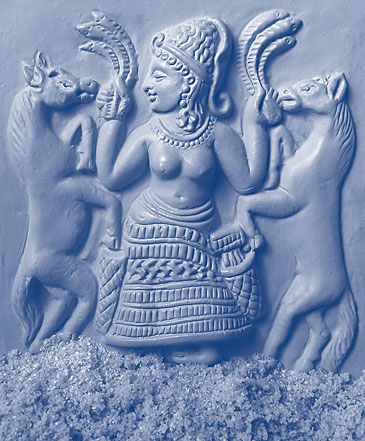
The bull and the dove are especially sacred to Astarte and Astoreth. The Goddess is often pictured wearing horns. The horns could also be a crescent moon symbol, part of the triple goddess symbol. Astoreth is sometimes pictured wearing the head of a Bull


The egg is a sacred symbol of Astarte, representing fertility, new life and the powers of the Goddess. Also in her role as a fertility Goddess she is often depicted holding an ever flowing jug of water whilst surrounded by flowers and grain.

In her guise as a goddess of war Astarte is seen carrying a bow and arrow much like Artemis. She is depicted riding horses and banishing weapons in several pieces of art that have been discovered.

Her image is most frequently seen on ancient seals or reliefs holding the sacred lotus in one hand and two entwined serpents in the other. The Lotus is a flower which is considered to be a universal symbol, connected to the Great Mother Goddess. Known as the "flower of light," lotus petals were been believed to represent the sun’s rays, while its stem was believed to represent an umbilical cord. The belief that the Lotus’ stem might represent an umbilical cord is indicative of the fact that all life stems from, or is born from, the Great Mother. The lotus flower therefore is a symbol of all that out mother earth provides for us and is associated with creative power, fertility, life  and growth.

Another symbol that was unique to Astarte was papyrus, which the merchants of Byblos would sell to the Greeks, as well as to other traders from the entire Mediterranean region. As the Goddess of wisdom in Blybos, papyrus was very important as the foundation for the production of paper.

Astarte is also associated with several animals such as lions, horses and the sphinx. Birds, particularly the dove, are important symbols for this goddess since they are used as a means of reaching the underworld and/or heaven.

Drawing on Astarte Wisdom Today

You can draw upon the ancient goddess power of Astarte by visualizing the light of the stars pouring down through your crown chakra surrounding you with an iridescent aura and filling you with her bountiful energy and protection. Call upon Astarte the Queen of the Stars whenever you have need of this protection.

Just as Astarte drew upon her inner strength and wisdom to face what lay ahead of her, so can we embrace this power.  She is a symbol of the independence and spirit that gives birth to our creativity and encourages us with our successes. Astarte is both the maiden and mother goddess and personifies the passion of life, the beauty of our mother earth and the sacredness of all beings.

In her roll of fertility Goddess you can ask for her help in this area. If you are seeking to become pregnant you can ask for her guidance or if you are starting a new project that you wish to spring into being, she will be there for you.

Decide what Astarte really means for you. Because she is such an ancient Goddess she has had many names and forms and been worshipped by many different people. Thus she has different strengths as seen by various cultures. You can therefore pick what resonates best for you at this time in your life. Perhaps you need strength, or rather you, need nurturing.  Astarte is a strong yet gentle Goddess and can be adapted to a host of different situations.

Astarte Poems

"She was the Mother of the Moon, Daughter of the Sun, Ruler of the Stars and Keeper of the Earth. In the beginning, Astarte was the whole.” unknown

“Great Bountiful Goddess of Antiquity
Your sacred fires are again lighted
Your name is again spoken with reverent awe
The High Places are no longer abandoned
Your Sacred Altars are again tended
Earth is re-awakening to your voice.” Unknown

“Isis, Astarte, Diana, Hecate, Demeter, Kali, Inanna,” Wiccan energy chant

Picture credit shttp://lunalioness.wordpress.com/


Astarte blessings to you, Alison

References:

Patai, Raphael 1990 (1978). The Hebrew Goddess: Third Enlarged Edition. Detroit, MI: Wayne State University
Tubbs 1998:140-141
The American Heritage® Dictionary of the English Language: Fourth Edition. 2000)

Monday, 28 January 2013


Meteors for 2013-Star Gazing! x*´¯`•.¸¸. ♥

I don't know about you but I am always looking at the moon and the stars so I thought I'd look up when all the next meteor showers were so we could make a note of them. So next good ones are not till the Perseids in August but a few