ctrl+v
Showing posts with label persephone. Show all posts

Sunday, 15 September 2013

Goddess Astarte Queen of the Heavens: History, Legends and how you can learn from her today.


History of Astarte

Astarte is one of the oldest goddesses in recorded history.  She was worshipped in many guises as a goddess of fertility, wisdom, love and war. She was also known as Astarat and Ashtart. She was worshipped throughout the Middle east and many worshipped her including the Phoenicians/Canaanites, Egyptians and Hebrews. Astarte also appears to have been worshiped in Syria as Atargatis and this worship covered a large area from Syria across the Mediterranean. This name seems to have come from a combining of the names Astarte and Anat. According to Patai, the "original meaning of the name Astarte was 'womb' or 'that which issues from the womb,' thus it can be easily seen her link as a fertility goddess (Patai 1990:57)


Among the Hebrews, Astarte was also known as Ashtoreth and they worshipped her alongside Ba’al. Once the rise of monotheism began and the popularity of Yahweh, people began to reject Goddesses such as Astarte/Ashtoreth and her popularity declined.

The prophet Jeremiah called her the Queen of Heaven during the 7th and early 6th centuries B.C.E and the people of Judah feared that abandoning the worship of the goddess would lead to problems:
“Ever since we stopped burning incense to the Queen of Heaven and pouring out drink offerings to her, we have had nothing and have been perishing by sword and famine.” (Jeremiah , 44:18)
To the Egyptians, Astarte was honoured as a Goddess of War and tenacity. In the Egyptian mythology she was thought of as the daughter of Ra the Sun god along with the Goddess Anat. The Romans also looked upon her as their Goddess of Hunting and War. Astarte would often join the hunt at the full moon and reward the hunters with special gifts.

To the Semites, she was a Goddess of Love and Fertility. Pregnant women would carry plaques and figurines of her wherever they went, and they would often burn incense in her honour as a way of ensuring that they would give birth to healthy children.

Legends of Astarte

In the Phoenician pantheon Astarte appears as a daughter of Epigeius (Greek: Uranus) and Ge (Earth), and sister of the god Elus. Elus ovethrows his father and as a trick  Epigeius sends Astarte along with her sisters to seduce Elus. The trick seemingly backfires as all three become wives to their brother and Astarte bears him seven daughters and two sons. Astarte becomes a great ruler and wears the horns of a bull to signify her power. Whilst wandering through her kingdom, Astarte takes up a star that has fallen from the sky and consecrates it at Tyre. Hence her title of Queen of the Stars

A story exists which is often associated with Astarte in her aspect as the Goddess of Fertility. Every Autumn, Astarte descended into the Underworld to search for her beloved Tammuz. When she left to go down into the Underworld, the Earth entered the cold barrenness of Winter, and it stayed that way until she returned, three months later, bringing with her the rebirth and growth that is associated with the season of Spring. This story has echoes of the story of Persephone going into the underworld to be with Hades only to return in the Spring when the world re-awakens.

Scholars who have studied Astarte see similarities between her story and that of the virgin Mary. In Syria and Egypt she was celebrated on 25th December with the dramatisation of the re-birth of the solar god from the celestial virgin. It is because of this legend that  of Astarte's holy days was associated with Yule, and it is believed that she created the Evergreen Tree out of her sorrow and love for Tammuz
Another legend surrounding Astarte is that she was the mother of all souls: the moon surrounded by her star children to whom she gave their astral bodies.

Some say that the word Easter derives from the word Astarte although it is commonly thought that it derives from Oestara. 

Another story states that Astarte descended to earth as a fiery star, landing near Byblos in a lake at Alphaca, the site where the original Tammuz is said to have died.

Astarte’s oldest known temple was at Byblos. Byblos is a city, which lies on the coast of the Mediterranean Sea, in the country that is now known as Lebanon. Byblos was a major trading city and Astarte was a key figure seen as a Goddess of learning and wisdom. The Phoenicians extended the worship of Astarte. From cities such as Byblos, Tyre, and Sidon, they set forth by sea on long trading expeditions, and, venturing far and wide, they even reached Cornwall in England!
The Greeks were the first people to call papyrus by the term “byblos,” and that term eventually evolved into meaning any holy book, including the Bible. Legend also tells us that this may be how and where the Bible got its name
Astarte has been associated with goddesses such as Artemis, Aphrodite and Inanna and indeed these goddesses could represent Astarte under a different name. She was known as Inanna to the Sumerians, and Ishtar to the Babylonians. The Greeks identified her with Aphrodite and the Romans with Venus, this could explain her being linked to the evening star.

Symbols for Astarte

Astarte on her many names and guises has had many symbols associated with her. She was known as the ‘Queen of the Stars’ . According to legends Astarte fell from the stars to the earth. One of her symbols is a star within a circle to represent her status as ‘Queen of the stars’ or the evening star for which she is also known. As the "Queen of the Stars," or the "Heavenly Virgin,” Astarte was believed to rule the "spirits who lived in heaven as light,"

The bull and the dove are especially sacred to Astarte and Astoreth. The Goddess is often pictured wearing horns. The horns could also be a crescent moon symbol, part of the triple goddess symbol. Astoreth is sometimes pictured wearing the head of a Bull
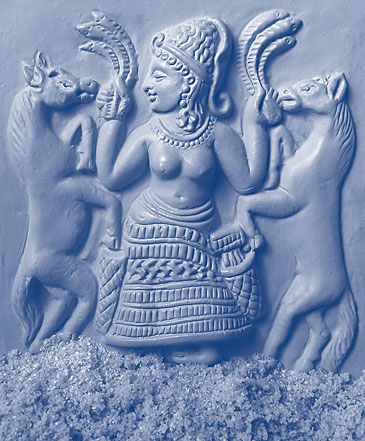

The egg is a sacred symbol of Astarte, representing fertility, new life and the powers of the Goddess. Also in her role as a fertility Goddess she is often depicted holding an ever flowing jug of water whilst surrounded by flowers and grain.

In her guise as a goddess of war Astarte is seen carrying a bow and arrow much like Artemis. She is depicted riding horses and banishing weapons in several pieces of art that have been discovered.

Her image is most frequently seen on ancient seals or reliefs holding the sacred lotus in one hand and two entwined serpents in the other. The Lotus is a flower which is considered to be a universal symbol, connected to the Great Mother Goddess. Known as the "flower of light," lotus petals were been believed to represent the sun’s rays, while its stem was believed to represent an umbilical cord. The belief that the Lotus’ stem might represent an umbilical cord is indicative of the fact that all life stems from, or is born from, the Great Mother. The lotus flower therefore is a symbol of all that out mother earth provides for us and is associated with creative power, fertility, life  and growth.

Another symbol that was unique to Astarte was papyrus, which the merchants of Byblos would sell to the Greeks, as well as to other traders from the entire Mediterranean region. As the Goddess of wisdom in Blybos, papyrus was very important as the foundation for the production of paper.

Astarte is also associated with several animals such as lions, horses and the sphinx. Birds, particularly the dove, are important symbols for this goddess since they are used as a means of reaching the underworld and/or heaven.

Drawing on Astarte Wisdom Today

You can draw upon the ancient goddess power of Astarte by visualizing the light of the stars pouring down through your crown chakra surrounding you with an iridescent aura and filling you with her bountiful energy and protection. Call upon Astarte the Queen of the Stars whenever you have need of this protection.

Just as Astarte drew upon her inner strength and wisdom to face what lay ahead of her, so can we embrace this power.  She is a symbol of the independence and spirit that gives birth to our creativity and encourages us with our successes. Astarte is both the maiden and mother goddess and personifies the passion of life, the beauty of our mother earth and the sacredness of all beings.

In her roll of fertility Goddess you can ask for her help in this area. If you are seeking to become pregnant you can ask for her guidance or if you are starting a new project that you wish to spring into being, she will be there for you.

Decide what Astarte really means for you. Because she is such an ancient Goddess she has had many names and forms and been worshipped by many different people. Thus she has different strengths as seen by various cultures. You can therefore pick what resonates best for you at this time in your life. Perhaps you need strength, or rather you, need nurturing.  Astarte is a strong yet gentle Goddess and can be adapted to a host of different situations.

Astarte Poems

"She was the Mother of the Moon, Daughter of the Sun, Ruler of the Stars and Keeper of the Earth. In the beginning, Astarte was the whole.” unknown

“Great Bountiful Goddess of Antiquity
Your sacred fires are again lighted
Your name is again spoken with reverent awe
The High Places are no longer abandoned
Your Sacred Altars are again tended
Earth is re-awakening to your voice.” Unknown

“Isis, Astarte, Diana, Hecate, Demeter, Kali, Inanna,” Wiccan energy chant

Picture credit shttp://lunalioness.wordpress.com/


Astarte blessings to you, Alison

References:

Patai, Raphael 1990 (1978). The Hebrew Goddess: Third Enlarged Edition. Detroit, MI: Wayne State University
Tubbs 1998:140-141
The American Heritage® Dictionary of the English Language: Fourth Edition. 2000)

Sunday, 14 July 2013

Lammas/ Lughnasadh History and Traditions


Lammas or Lughnasadh (Loo-nahs-ah) falls on the 1st August. It is a cross-quarter holiday festival which lies between the Summer Solstice (Litha) and the Autumnal Equinox (Mabon). In the northern hemisphere, Lammas takes place around August 1 with the Sun near the midpoint of Leo in the tropical zodiac, while in the southern hemisphere Lammas is celebrated around February 1 with the Sun near the midpoint of Aquarius.  

Lammas or Lughnasadh is the festival of the first harvest, traditionally it was a time for giving thanks for all that our Mother Earth, Gaia has provided; with a particular focus for the grain that has been grown that would sustain people during the long cold winter months. It is also seen as a fertility festival as the earth is ripe with her fertility at this time of year.  Other names and spellings for this point on the Wheel of the Year are Frey Fest, Lughnasa, Lughnassad, Feast of First Fruits, Habadonia, Threshold of Plenty and Lugnasad. In old Irish a variant Lunasa means August.


The name Lughnasadh, Lughnassad or Lugnasad is named from the Gaelic God Lugh, the God of Light and the son of the Sun. At the time of Lughnasadh, the Sun God Lugh transfers his power into the grain, and is sacrificed when the grain is harvested.  The God Lugh sacrifices himself so that his people might live and the power of the sun is thus transferred into the grain as it ripens. Lughnasadh also has an older name, Brón Trogain, which refers to the painful labour of childbirth. This is because, at this time of year, the earth gives birth to her first fruits so that her children might live.

The grain that Lugh has sacrificed himself for is harvested and made into the first loaves of the season. This was often done with great ceremony as it was seen as very significant. This is also the origin of the name Lammas, from the Saxon hlaef-masse or loaf-mass. The seeds from the first harvest are saved to be planted for next year’s crop and thus the Sun God Lugh will be resurrected and his strength, warmth and courage will be given to the new grains.


Wheel of the Year by nahimaart on DeviantArt
Beautiful artwork can be found here:
Another version of this story of the God Lugh tells that Lugh decreed that a commemorative feast should be held every year at the beginning of the harvest season In order to  honour his foster mother, Tailtiu. Tailtiu’s name is from Old Celtic Talantiu, "The Great One of the Earth," suggesting she may originally have been a personification of the land itself, like many Irish goddesses.

 Tailtiu was the royal Lady of the Fir Bolg. The Firbolg were an ancient race of people that ruled Ireland before the Tuatha de Danaan and the Melesians.  After the defeat of her people by the Tuatha De Dannan( the people of the Goddess Dana) she was forced by them to clear a vast forest for the purpose of planting grain. She died of exhaustion in the attempt. When people gathered at her death-bed, she told them to hold games in her honour. She said that Ireland would be forever happy and full of song as long as these games were held every year. This version of the Sun God Lugh's story seems a more likely explanation as we hear later legends that say that the Sun God does not die until the Autumnal Equinox.

According to the legends, Tailtiu was buried beneath a great mound named after her. This is the spot where the first feast of Lughnasadh or Lammas was held in Ireland, the hill of Tailte. At this gathering were held games and contests of skill as well as a great feast made up of the first fruits of the summer harvest. These games were known as the The Tailtean games. The Tailtean games saw many feats of strength and speed to celebrate the dying sun to be re-born again.

These celebrations also gave rise to the tradition of Teltown marriages. These were similar to the tradition of handfasting and were an arrangement for lovers to be bound for a year and a day. Such trial marriages were quite common even into the 1500′s. These ceremonies were usually solemnized by a poet, bard, or  Pagan priest or priestess.
Other Goddess that are celebrated at this time of year are Bast (Egyptian), Ceres (Roman), Demeter (Greek), Gaia (Greek), Ishtar (Assyro-Babylonian, Rhiannon (Welsh) The legend of Persehone and Demeter is particularly appropriate for this time of Lughnasad. Persephone is representative of the grain seed and her descent into the underworld shows us the seed lying underground during the winter. Demeter the Mother goddess represents the ripe harvest in abundance at Lammas.


Lammas by Jezebelwitch on DeviantArtJezebelwitch


As Lammas is a festival of the first harvest a lot of celebrations have centred around the gathering of the crops. Corn-dollies have had a very prominent feature in celebrations across time and across the world in various cultures, both Pagan and non Pagan. Other names for the corn-dolly are the kern-baby or corn-maiden. This figure, braided into a woman's form from the last harvested sheaf of grain, was said to represent the Harvest Spirit. People hung these corn dollies over their fire places for luck.  Traditionally the corn dollies that had been woven at Lammas (or their ashes) were ploughed back into the land at Imbolc, thus symbolising the return of the Corn or Harvest Spirit back to the earth. In this way a bountiful harvest was hoped for the next year.  Different areas often had their own particular designs of corn dolly, often woven with beautiful bright wool and ribbons. Another European tradition was to weave a large corn dolly with a smaller one inside it to represent next year’s unborn harvest.


Amongst other typical Lughnasadh traditions included the gathering of wild berries and the climbing of hills as well as the visitations to holy wells. Very often ceremonial Lammas bread was baked in various shapes.  It is said that the bread represents the body of the fallen god Lugh.

On Lammas eve fires were lit on Lammas mounds to honour the corn mother. The fires represent the dying sun.

Lammas was a traditional time for craft festivals. Medieval guilds would display their wonderful wares with creative displays. They would often decorate their shops and themselves and march in wonderful parades. These were expanded into fabulous carnivals with plays and dancing. A highlight of these was the lighting of a Catherine wheel. A wagon wheel was set alight at the top of the hill covered in tar. This symbolized the ending of summer. The Church moved St. Catherine’s feast day all around the calendar its most popular date was traditionally on Lammas day. The name for the firework the Catherine Wheel still survives today. 
  
Lammas feasts often lasted for a period of a month from fifteen days before 1st August until fifteen days after. Horse fairs in honour of The Goddess Rhiannon were traditionally held around the country. In the north of England these fairs were called the Wakes. Wakes weeks are a custom that still continue today, although the original origins may have been forgotten.

It became a custom to give people the gift of a pair of gloves at Lammas or Lugnasad. This was partly because winter is just around the corner, but it is also related to an old tradition in which landowners gave their tenants a pair of gloves after the harvest. The glove is a symbol of authority and benevolence.

All around the world people recognize the importance of giving thanks at this time in the wheel of the year. The first harvest is a time to be grateful to our Mother Earth Gaia for all that she provides for us. This harvest sustains us during the winter and thus we have much to be thankful for.

Many competitive games around the world echoe the Talitean games. Most famous of these is of course the Olympic games traditionally held at this time of Lammas. Other traditional games are the Panatheniac Games and the Highland Games ; not forgetting the start of the modern football season.

In ancient Phoenicia this festival honored the grain god Dagon, and a significant portion of the harvest was sacrificed to him


In late July in celebration of this time of the wheel of the year in Greece the God , Adonis  was honored with an eight day  festival. His festival coincided with the appearance of Sirius, the Dog Star and the beginning of the extreme heat of this time of year. (It was believed that the appearance of the star added to and magnified the effect of our own Sun.)  It was also believed that Adonis spend half the year with Aphrodite (during which the Earth bloomed) and half the year with Persephone (which was winter).


In Israel, the festival of Shavout commemorates the beginning of the harvest, as well as honoring the date that Moses received the Torah on Mt. Sinai. The final sheaf of wheat is brought to the rabbi for a blessing, synagogues and homes are decorated with flower, and a great feast is prepared for all to enjoy.

The Norse Lammas Day is called the festival of Sif of the Golden Hair. Her husband was the God Thor (God of thunder and rain). Sif's corn grows because of his fertilizing rain. Loki (trickster and teacher) who is associated with wildfire, heat and the Dog Star is honored during Lokabrena (Burning of Loki or Loki’s Brand) for the ripening and cutting of the crops.


In Scotland, the first cut of the harvest was made at Lammas in a ritual called the “Iolach Buana”.
It was also called called "Bilberry Sunday.” Bilberries (or blaeberries), close relatives of the American blueberry, were considered to be a sacred fruit. On this day people would climb the nearest hill often named "Lughnasadh Hill" and gather the earth’s freely-given gifts of these wild berries. They are also known as wild sloe berries. These bilberries might have been worn as special garlands or gathered in baskets to take home to make jam, bilberry wine, or Fraughan Cake which is another word for these berries still used 
in Ireland today. Some bilberries or fraughans were always also left behind on a special cairn or rock as an offering to our mother Earth for a bountiful harvest and in promise of a good harvest next year.

In India the festival of Onam is celebrated in honour of King Mahabali. In one story Mahabali ends up buried under the earth by the god Vishnu but is allowed to return once a year, symbolizing the planting of the seed followed by the harvest.
Many Native American tribes celebrated this time on the wheel with the Green Corn Festival. They tell stories about  the Corn Woman, Blue Corn Girl and Corn Maiden. Green Corn festivals are still practiced today by many different native peoples of the Southeastern Woodland Culture. These colourful festivals are celebrated with feasting singing and dancing, thanking our earth for the bounty she provides.

In Egypt the time of Lammas co-incides with the flooding of the Nile at the same time as the appearance of Sirius the dog-star. Therefore Sirius is known as Septit the “Water Bringer” and is identified with Isis, the consort of the vegetarian God Osiris. It is thus believed that her magick has brought him back to life and the Festival of Isis Seeking Osiris in the Darkness is held.

In Belarus they celebrate the pagan ritual Yurya celebration. People believe that the pagan god Yurya protects their harvest and the annual tradition is devoted to plentiful future harvests.


After all the charged energy of the summer, Lammas marks a time to start to look inward and reflect, it is a time to renew and regenerate our spirit. From the joy of community gatherings to the deep experiences of ritual space, Lammas reminds us of the turning of the wheel.

Lammas or Lughnassad is a great time to celebrate, having a feast with friends and giving thanks for all that we have. Lammas bread may be baked representing the grain mother and shared out amongst friends.

Lammas is a perfect time to finish off projects that you began in the summer, particularly outdoor projects, for example clearing the weeds in your garden.
Lughnasadh is a time of personal reflection and harvest, of our actions and deeds, events and experiences, our gains and losses. This magickal time of Lammas is a time when we look to reflect upon the changes that are taking place right now. This is a wonderful period for personal fertility magic to ensure the bountiful harvest of life's gifts and experiences, that which we have reaped though trial, tribulation, enjoyment, joy, love and loss.

We are reminded once again of the cyclic universe; endings are merely new beginnings. Lugh the Sun King dies now at the time of Lammas. His energy and strength goes back into the grain and is given back to the land ready to be born again next spring. We are reminded because of this of the circle of life and how crucial this is.
Enjoy this time of Lammas however you intend to celebrate it. I have tried to find as much information as I can about the history surrounding this time on the wheel of the year across the globe. If you have any other stories to tell of how Lammas was celebrated in the past or present I would love to hear from you.

Sources: I have found my information from various sites all over the internet. Also the following books are excellent sources for wheel of the year information:
Pagan in the City: How to Live and Work by Natural Cycles in the Everyday World Sacred Celebrations : A Sourcebook
Creating Circles & Ceremonies: Rituals for All Seasons And Reasons


Brightest blessings of the Sun god Lugh to you, Alison xxx