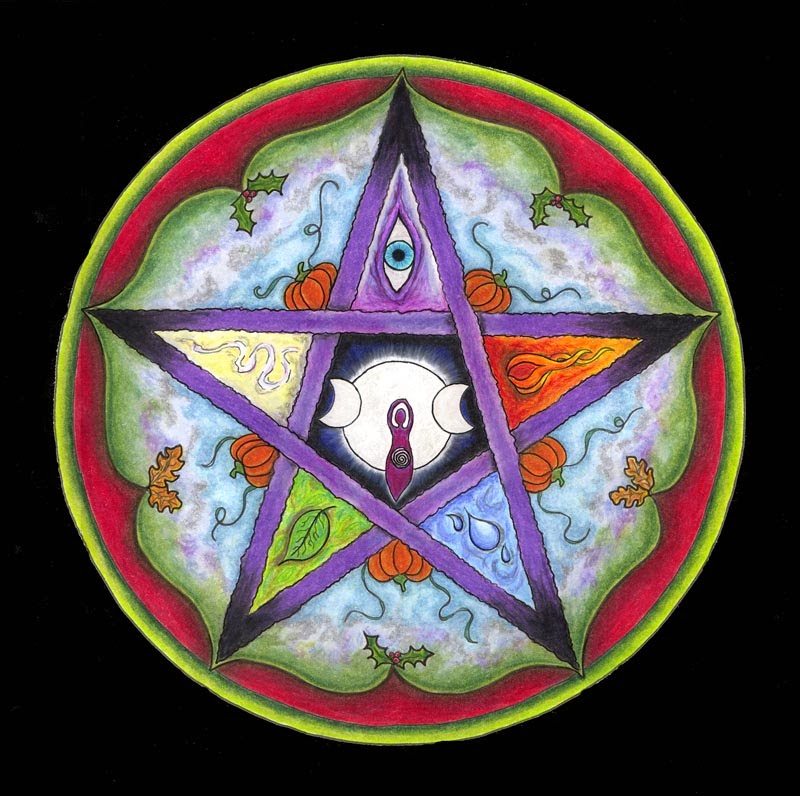
Samhain
What is the festival of Samhain and how is it celebrated?
Samhain (pronounced
sow-en)
is celebrated on 31st October in the Northern hemisphere and 1st
May in the southern hemisphere. The weather is getting colder and the nights
are drawing in. We are reminded of the change of the seasons and the wheel
turns to Samhain. Samhain is Gaelic for
"summer's end, taken from the word “Samhuin,” It is also
thought to take it’s name from the Gaulish Colligny calender that names October
as Samonios. Samhain has been known by
various alternative names: Some Celtic Wiccans and Druids call it Calan Gaeaf,
Calan Gwaf, Kala-Goanv, or Nos Galan Gaeof. In Welsh, it is Nos Cyn Calan
Gaual. It also is known as Oie Houney. In countries around the world it is
known as ‘the Day of the dead’
At Samhain we particularly honour our ancestors as the division
between our world and the spirit world is at its thinnest. Samhain was a
particulary important festival In Celtic Ireland about 2,000 years ago, it was
celebrated as the division of the year between the lighter half (summer) and
the darker half (winter). In Pagan terms Samhain is often thought of as the
start of the new year. Traditionally it
was thought that the dead returning to visit their kin at Samhain and the doors
to the Lands of the Sidhe (pronounced "shee") or Faery Realm were
opened.
Eliade's Encyclopedia
of Religion says: "The Eve and day of Samhain were characterized as a time
when the barriers between the human and supernatural worlds were broken... Not
a festival honoring any particular Celtic deity, Samhain acknowledged the
entire spectrum of nonhuman forces that roamed the earth during that
period."
Samhain marks the third and final
harvest of the year. This is the time that fruit such as blackberries and
apples are harvested, hence the importance of apples in Samhain and Halloween
traditions. Late October was also
the nut harvest for Celts, and the time for salting winter's supply of meat. The Sun God is sacrificed back to the land until the
Winter Solstice, and the Crone Goddess mourns Him until His rebirth at Yule.
Ancient traditions of Samhain
In Irish lore the Tuatha de Danann arrived in Ireland on
Beltane (like the people of Cesair and Partholon before them) They fought their
first great battle against the Fir Bolg soon after. The major, defining battle
though was the war against the loathsome Fomori, this war is described as
occurring on Samhain.
A similar tale can be found in the story of the
destruction of Tara. A bard of the Sidhe called Aillen mac Midgna cast a
sleep-spell over the inhabitants of Tara using his timpan (like a zither) Every
Samhain night for 23 years his fiery breath burnt the hall to the ground, and it
had to be rebuilt over the winter. This continued until the time when the young
hero Fionn Mac Cumhail, arriving for the Feast of Tara, sticks a spear through
him. Another tale is that the Tuatha de Danann
bring four talismans, one of which is the Great Fál or the “Stone of
Knowledge.” Ancient lore tells that this stone was one of four stones
positioned in the cardinal directions on Tara.
This time on the Wheel of the
Year was so important to the ancient peoples of Ireland that they built a
megalithic mound at the Hill of Tara to mark it’s observance.
“Inside
the mound of Tara, it is dark, all
around is the chill of pre-dawn, the only
sounds are the sounds of breathing. Suddenly the dark chamber is illuminated
by a brilliant light. It is the rising sun on one of the two most important
days of the Celtic year, it is Samhain.” - Gabrielle Diana Laney
Both the story of the Tuatha de danann and Tara show the destruction
of an oppressive force. It follows therefore that Samhain is seen as a time to
release negative forces.
The Celts inherited extensive knowledge
about the solar and lunar movements from their Neolithic predecessors in
Europe. The bronze Coligny Calendar, found near Lyon, France, was more accurate
than the one used by the Romans. Scholars have found that these feasts
correspond closely to the solar alignments of the megalithic mounds, where
Samhain, the Celtic New Year was the greatest feast marking the culmination of
the Harvest Festivals.
This structure
is said to be Ireland’s Stonehenge, a 4,500-year-old structure at the Hill of
Tara in Co Meath, has been re-created by archaeologists and computer-graphics
experts. Monuments found at Newgrange, Knowth
and Dowth show the importance of Samhain and our earth’s natural rhythms and
more work is taking place to try and work out the complex symbology.
To commemorate Samhain, our ancestors, the Druids built huge
sacred bonfires, where the people gathered to celebrate. In Scotland, these bonfires were called samhnagan, and they
were usually made from flammable materials like ferns, tar-barrels, and
anything else that would burn. During the celebration, the Celts wore
costumes, and attempted to tell each other's fortunes. When the celebration was
over, they re-lit their hearth fires (which they had extinguished earlier that
evening) from the sacred bonfire to help protect them during the coming winter.
Samhain was one of only two days- the other being
Beltane-when it was considered correct to extinguish the "hearth
fire" and then to re-light it. If your fire failed at any other time of
the year, it was thought to be bad luck. It was also customary to light a new candle for the "new
year".

The importance of fire and its
connection to the sun is explained as follows: “The perceptible, and apparent,
decline in the strength of the sun at this time of year was a source of anxiety
for early man and the lighting of the Winter Fires here symbolised man’s
attempt to assist the sun on its journey across the skies. Fire is the earthly
counterpart of the sun and is a powerful and appropriate symbol to express man’s
helplessness in the face of the overwhelming sense of the decay of nature as
the winter sets in.” Tiachgta: Celtic Fire festival by by John Gilroy.
Food was usually prepared at Samhain for the living and the dead.
A place was often laid for any dead loved ones. Food prepared for the ancestors who were in no position it
eat it was ritually shared with the less well off. Many people left milk and cakes called Bannock Samhain outside their
door on Samhain Eve
By 43 A.D., the Roman Empire had conquered the majority of Celtic
territory. In the course of the four hundred years that they ruled the Celtic
lands, two festivals of Roman origin were combined with the traditional Celtic
celebration of Samhain. The first was Feralia, a day in late October when the
Romans traditionally commemorated the passing of the dead. The second was a day
to honor Pomona, the Roman goddess of fruit and trees. The symbol of Pomona is
the apple and the incorporation of this celebration into Samhain probably
explains the tradition of "bobbing" for apples that is practiced today
on Halloween.
With the coming of Christianity in the 800s AD, the early Church
in England tried to Christianize the old Celtic festivals. Christianity
incorporated the honouring of the dead into the Christian calendar with ‘All
Hallows Eve’ on the 31st, All Saints (All Hallows) on November 1st,
followed by All Souls on November 2nd. Together, the three celebrations, the
eve of All Saints', All Saints', and All Souls' day, are called Hallowmas.
Ancient traditions surrounding these festivals were very much based on the
earlier Pagan beliefs.
Throughout time many traditions have blended into Halloween, for
example the American harvest time tradition of carving pumpkins. The Irish
emigrated to America in great numbers during the 19th century especially around
the time of famine in Ireland during the 1840's. The Irish carried their
Halloween traditions to America, where today it is one of the major holidays of
the year.
 The Celts regarded the human head as
the ‘Seat of the Soul’ the concept of the carved pumpkin with a candle inside
it as the Light shining from the Soul.
These early lanterns wer given the name Jack-o-Lantern and were often
carves out of turnips rather than pumpkins. The name "Jack-O-Lantern" means "Jack of the Lantern,
" and comes from an old Irish tale. Jack was a man who could enter neither
heaven nor hell and was condemned to wander through the night with only a
candle in a turnip for light. The story goes that
Jack was a miser and when he died, he was not allowed into heaven and he also
played jokes on the Devil, so he was not admitted into Hell either. He only had
a small lantern to light his way and this is why he came to be called
Jack-O-Lantern. It is also an old legend that candle
flames that flicker on Samhain night are being touched by the spirits of dead
ancestors.
The Celts regarded the human head as
the ‘Seat of the Soul’ the concept of the carved pumpkin with a candle inside
it as the Light shining from the Soul.
These early lanterns wer given the name Jack-o-Lantern and were often
carves out of turnips rather than pumpkins. The name "Jack-O-Lantern" means "Jack of the Lantern,
" and comes from an old Irish tale. Jack was a man who could enter neither
heaven nor hell and was condemned to wander through the night with only a
candle in a turnip for light. The story goes that
Jack was a miser and when he died, he was not allowed into heaven and he also
played jokes on the Devil, so he was not admitted into Hell either. He only had
a small lantern to light his way and this is why he came to be called
Jack-O-Lantern. It is also an old legend that candle
flames that flicker on Samhain night are being touched by the spirits of dead
ancestors.
Samhain was a time for celebrating
your ancestors and many people visited graves of their loved ones at this time.
They often brought food, holy water and flowers to decorate the graves and
honour their loved ones.
The wearing of costumes and masks to ward off harmful spirits
survived as Halloween customs. "Trick-or-treating" is a modern
tradition that dates back to early Pagan times.
The wearing of costumes is an ancient practice; villagers would dress as
ghosts, to escort the spirits of the dead to the outskirts of the town at the
end of the night's celebrations. It is also thought that the wearing
of costumes and masks warded off harmful spirits. The wearing of these
disguises was known as ‘guisng’ or ‘mumming’. Playing practical jokes was very
popular at this time, the revelers dressed up and went around the towns and
villages to play tricks on people.
In England on all souls day poor citizens would beg for food and
families would give them pastries called "soul cakes" in return for
their promise to pray for the family's dead relatives. The distribution of soul
cakes was encouraged by the church as a way to replace the ancient practice of
leaving food and wine for roaming spirits. The practice, which was referred to
as "going a-souling" was eventually taken up by children who would
visit the houses in their neighborhood and be given ale, food, and money.
Divination was carried out
extensively at Samhain. Divinations were often performed e to find out the
identity of one's future spouse, the location of one's future home, and how
many children one might have.
Samhain around the world.
The Hindu Diwali (Divali, Deepavali) Festival known as the
Festival of Lights occurs about the same time as Samhain. Diwali marks the
Hindu New Year just as Samhain marks the Celtic New Year, it seems possible
that the two have come from similar roots.
Mexico observes a Day of the Dead (Spanish: Día de Muertos) on this day, as do other world cultures. In Mexico it is a time to
celebrate with family and to remember one’s ancestors. People visit cemeteries
and build altars to remember their loved ones. Even today it is national
holiday with the banks and shops closing so that people may celebrate the day
of the dead.
In Guatamalia they celebrate the ‘Day
of the Dead’ by building and flying huge kites.
In Ecuador the Day of the
Dead is particularly important to the Kichwa who make up an estimated quarter of the population. Families gather
together in the community cemetery with offerings of food for a day-long
remembrance of their ancestors.
In Haiti the traditions of voodoo and
catholisism are combined for an all night celebration with loud music and
drumming. These celebrations are supposed to waken ‘Baron Samedi’, the Loa of
the dead and his family.
Celebrations in Austraila and
Indonesia follow similar traditions to the Mexican day of the dead and involve
visiting graves and placing flowers on them.
In the Phillipines, the holiday is
called Todos los Santos (All Saints Day), Undas (from Spanish andas,
or possibly honra), or Araw ng mga Patay (Day of the Dead), and
is a celebration of family.
In Brittany in France people flock
to the cemeteries at nightfall on Samhain to kneel, bareheaded, at the graves
of their loved ones and to anoint their tombstones with holy water.
On 31 October, the locals on
the Scottish island of Iona would go down to the shore. One man would wade into
the water up to his waist, where he would pour out a cup of ale and ask ‘Seonaidh’ an old pagan god – to bestow
blessings on them all.
On the Isle of Man they celebrated
Hop-tu-Naa on 31 October, which is a celebration of the original New
Year's Eve. The term is Manx Gaelic in origin, possibly from Shogh ta'n Oie,
meaning "this is the night" Children carried turnip lanterns and sang
Hop-tu-naa songs. ‘Jinnie the Witch’ is a song which is still sung today.
The modern song goes as
follows :
Hop-tu-Naa
My mother's gone away
And she won't be back until the
morning
Jinnie the Witch flew over the
house
To fetch the stick to lather the
mouse
Hop-tu-Naa
My mother's gone away
And she won't be back until the
morning
Hop-tu-Naa, Traa-la-laa
A cake was made at Hop-tu-Naa which
was called Soddag Valloo or Dumb Cake, because it was made and eaten in
silence.
Modern Day Samhain celebrations.
How you choose to celebrate Samhain
is very much a matter of personal choice. Many traditional acts such as trick
or treating, pumpkin carving and apple bobbing are fun to carry out especially
if you have young children.
Samhain is also a calmer celebration
when we honour the spirits of our departed loved ones. You may like to light
candles, visit graves and build altars to celebrate those you have lost. Many pagan and Druid ceremonies concentrate on the importance of our departed love ones.
 |
| Samhain at the Rollright stones |
Further information on celebrating
Samhain may be found in my article ‘20 ways to celebrate Samhain’
Sources and further reading:
Sources: I have found my information from
various sites all over the internet. Also the following books are excellent
sources for wheel of the year information:
MacKillop, J, Dictionary of Celtic
Mythology, Oxford University Press, Oxford, 1998
Tiachgta: Celtic Fire festival by by John
Gilroy.
Eliade's Encyclopedia
of Religion